Friday, 30 September 2016

Researching classical plays - Shakespeare's; Midsummer Night Dream

Brief History Link to Globe History - http://www.shakespearesglobe.com 
The Globe theatre exists today to serve as a popular, historical and traditional home to the performances of Shakespeare's literature. This all came about during the start of the Elizabethan Era where English actors and playwrights would form companies and perform in inns, yards, college halls and the pImage result for original globe theatrerivate houses of the wealthy upper class.
In 1576 an actor and manager called James Burbage built the first purpose built theatre (playhouse) in Shoreditch, Shakespeare and other actors grouped together to form the company; the Chamberlains, later known as the Kings Men which went on to create perform for 20 years.
Image result for new globe theatreAfter James Burbage passed, the lease for the theatre was under heavy dispute. As a drastic action, the theatre company rented out some land across the other side of the river, knocked down the old theatre and used the materials to build the Globe. In order for the costs to be covered, shares were sold off to some members of the company such as William Shakespeare. For 14 years, Shakespeare used this company to perform many of his works. In 1613, whilst performing the play Henry vii, a stage cannon set alight to the thatched roof burning down the theatre. A replacement theatre was built with a tilled roof but was closed down and demolished during Oliver Cromwell's puritan reign of which theatre was banned.
An American actor and director called Sam Wanamaker spent many years fundraising, founding the Shakespeare Globe Trust dedicated to rebuilding a new Globe theatre as close to the original as possible. This Globe theatre is used today by the Globe Theatre Company who perform many of Shakespeare's plays.
Old and the New Construction
The original Globe was made from Oak timbers which were strong and easily craft-able yet much cheaper than building from stone. The walls were made of lime plaster and coated in lime wash becoming white. The modern Globe was built with the same materials to be as original as possible which includes using wooden pegs to keep everything together and the techniques used by the carpenters. The only modern aspects to todays Globe are the machines used to construct everything on site and the health and safety requirements such as fire alarms, fire escapes and fire proofing.

Seating and Standing
The globe theatre's consists of three levels. Level one houses the yard, a large area right in front and to the sides of the stage where people stand and  the lower gallery. Level two consists of the middle gallery and gentlemen's rooms and level three has the upper gallery. There are also the balconies which the original theatre would have used but are now used for actors or musicians. The seats are all benches with the gentlemen's rooms being more comfortable.
- video of a news report during the building of the globe - link - https://youtu.be/N_QjrZN5vrM 


'A Midsummer Night's Dream' - Link to information - https://www.rsc.org.uk/shakespeares-life-and-times/performing-shakespeare-in-the-17th-century
A Midsummer Night's Dream would have first came about by William Shakespeare discussing the idea for the plot to the theatre company. Then the leaders of the company would decide if they liked it and offer a down payment so Shakespeare can complete it. This allowed the playwrights to write the play and create characters with actors in mind which meant if Shakespeare has a character with a long monologue he could chose an actor best suited to remembering the lines or if there is a particular accent he wanted his character to have, he new which actor would be able to do it best. An example of this character-actor basing is when Shakespeare chose the leading man of the company, Richard Burbage to play Richard the iii as he had the best memory. This differs to today's form of playwriting and casting because there is a playwright that writes a full script with characters that are created without the actors in mind. Once the play is finished, the playwright has to advertise their play and find people willing to invest in the production and a location of production. Once these foundations are laid, people with the right skills accordingly have to be hired such as directors, technicians and managers through casting websites and connections. Then the company needs to open auditions top find actors for the play. Where Shakespeare and other Elizabethan playwrights would base their characters on the abilities around a particular actor in their company, a casting director is hired for the specific purpose of choosing the best actors (in their opinion) for the role. Then the actors are handed a full copy of the play where they are expected to read it all and fully understand the plot and their characters. This is very different to a Shakespearian actor as they would only be handed a script with their lines to prevent copyrighting the playwrights play and taking it for themselves and selling it off. The Shakespearian actors; to characterise, would have to formulate an idea from their lines but also take direction from Shakespeare himself. They would not know any of the other characters in the play yet nor how to react to them until rehearsals where they could experiment with movement and expressions and reactions of other actors on stage.
I believe that the process of finding the actor to play the character was a lot simpler and easier back in Shakespeare's time because the playwright already knew which actors were playing which character whereas todays process is much more complex for the playwright as they must go through a long, challenging process of auditions to find the right actor to play their character. I think that the process's are so different as nowadays there are so many actors trained in many different ways, that are adaptable, experienced and dedicated to their industry that means the playwright just cannot limit themselves to the people they know if they want perfection when it comes to the actor suiting the character.
Evidence for this point is that their were an estimated 4,000,000 people populated England in the 1600's - http://www.localhistories.org/population.html, whereas now the total UK population is estimated at 65,000,000 people - http://www.worldometers.info/world-population/uk-population/. I believe this extremely large population difference between then and now, with the added factor of international actors performing in the UK, shows how the process has become much harder and why play writing and casting has changed so much from Shakespeare's era.

The performing of this play originally would have been very different to todays version that we went to see. Firstly, the actors of that era would have been lower class men that were looked down upon in society for being common and rough. They would have been very skilled in acting and some being trained to only master certain character types. Also, there were no women actors so men were specifically trained to mastery of performing as a female, usually the young men who would sometimes be injected with feminine hormones so they could keep their high voices. This differs from today as being an actor is seen as a dream job and actors can have a very high standing in society with people becoming famous celebrities in the eyes of the media. This would not have happened in Shakespeare's era and if actors were to open about their career they would be shunned. Something actors would never do after a performance is walk around in costume or as character as this would have been an absurd by the public which contrasts with today as we find it entertaining when our favourite actors are in character maybe on the Graham Norton show for example. Another contrasting factor is that women are now in the industry. Some of the best actors in the world are women which shows how equal rights back in the 1600's was not at all as prominent as it should have been.

The music was a prominent factor in the modern interpretation of the 'Dream'. Shakespeare did use certain woodwind and string instruments and also had lots of singing and dancing in the play which I believe would make the audience receive the play better, say if some of the audience did not understand the language or like the characters, then Shakespeare knew that having music, dancing and singing would be a way to make the audience understand easier but also for the audience to join in and have fun. This was very similar to the one we watched as their were times were I was having great fun when the music was playing and the actors were dancing in silly ways and reacting to audience members and pulling faces.

Something different about the modern version is that it was very sexualised. There were many scenes and characters that were sexualised but one character in particular was Puck.

'Ill put a girdle around the Earth in forty minutes'

In the modern adaptation, Puck's arms flowed with flamboyancy, her eyes became locked onto a single audience member enticing them into a harsh gaze and shew would chose somebody from the audience to latch onto and touch or arouse. As she said this quote she ran off stage but with interactions that can only be described as cheeky, devious and lustful.
Now, in the original performance characters such as Puck would have never been as sexualised as  they are today. One reason being that all actors were men and it was not accepted in society to be homosexual and therefore would not have been welcomed for the character Puck to touch up audience members. I think that the modern adaptation of Puck could still have been played by a man but have been just as sexualised as the female Puck due to the homosexuality being accepted in our society.

Links:

The original Globe audience would have been formed by just about all different types of classes in the city of London. This remains the same today but with the added international audience members from across the globe from increase migration. I think the amount of culture in the audience now has affected and increased the diversity of the story telling. The modern version has adapted to their audience by adding in cultured music like the sitar, has a multicultural cast and has identified that sexualised content is found humorous. This contrasts due to the African and Arabic slave trade which meant there were minimal to zero rights for non Europeans therefore no integration of multiple cultures in society for many years on. I think this would have made the original performance different as the play would lack the cultural influence of music and comedy and would have been much more subdued knowing that the audience would either not understand or dislike anything that wasn't what they understood or educated upon.

Links:
http://anthro.palomar.edu/culture/culture_1.htm

Image result for shakespeares the globe seetingClass. City of London. Elizabethan era. You have your monarchs, royalty, Lords and Lady's, business men, working class, peasants and the homeless. Something special that Shakespeare; situated right in the middle of the classes, was able to do was bring all of these different people together in one room, something that was a rare occurrence when the poor are shunned and avoided by the rich who want nothing to do with each other.


Here be the existing Globe theatre as an example to demonstrate the class seating of the original theatre.                                                                                                                                   


The Yard and its Audience
The yard cost 1 penny to get into and there were no seats. The standing rabble were working called the groundlings or 'Pennystinkhards' as they were never cleaned or smelt like ale and garlic. The floor was thought to have been made up from sand and nut shells. Many members of society deemed the yard to filthy and would pay a little extra for an upgrade just to protect their moral standing.
There are 240 pennies in £1 and 1 loaf of bread cost 1 penny. If you compare this to todays ticket price for the yard; £5 which could buy you about 5 loaf's of bread, it's relatively dirt cheap. This is the reason why there were so many lower class people at the theatre so often as they could go after work to have a great time drinking and laughing. These crowds of people the theatre attracted were allowed to buy food and drink ale in the performance and were loud, drunken and usually under-educated which resulted in them not understanding the plot and throwing food at the actors. This is something that the actors had to overcome. They had to project much louder than today's performers due to this ignorant, rowdy noise so the people sitting higher up could here them. Also, they would have to be very clear with every movement, word and action they carried out as they are telling a story in a very different language that many audience members will not understand unless every action is carried out with meaning. Otherwise the crowd will boo and throw food and the play will be effected negatively. Also thieves were common in the crowd which caused fights. Today's audience in the stand are usually people that fancy a taste of what the lower class audiences would have experienced without the smells and rowdiness of it all. As a yard audience member, I feel like it has the most atmosphere as the actors walk past and interact. Also, I was closer to the stage which made me feel a connection with the characters making it very enjoyable during the comedy aspect which is exactly what Shakespeare wanted.

The Gallery and Beyond
The gallery cost 2 penny's and the audience members can sit down on a bench and watch the show with a roof over their heads next to slightly less 'common' co-audience making it much more comfortable. This 2 penny difference isn't much so I believe that the working class actually preferred standing and had a much more enjoyable time instead of wasting another penny to sit next to somebody that cares to much about their appearance to others or the rain. To upgrade for a cushioned seat it cost another penny. These seats were for the middle class but were still loud with people booing villains, cheering the special effects and laughing at the comedy. The boing and cheering aspect of the audience has changed today as audience members are a lot more respectful of the actors and conscious of other people and will be quiet during the play but will openly laugh at the comedy which I again believe was Shakespeare's ideology. This aspect of cheering and booing however has been transported out of classical plays and into pantomimes and contemporised for the younger generation. In my opinion, this aspect of booing and cheering would have made the modern version more entertaining as there was not much of this during the performance but at the end of the play there was suddenly a roar of cheers which projected the atmosphere and sent me travelling 400 years into the past.
The high class seating area was called the Gentlemen's stand and the balcony. These were two stands on either side of the stage and two areas just above the stage. These people were lords and lady's and wealthy advisories who paid a lot of money to sit facing the audience to literally show the audience members that they were wealthy and of high class. The people in the gentlemen's stands would still be able to watch the play. Today, the balconies are not used as seating areas and the gentlemen's stands are still the most expensive seats. I was looking around at different audience members during the running and noticed that certain people sitting in the gentlemen's stands were very well dressed up, had a glass of wine in their hand and were not as involved as the people in the yard with us. I also noticed that certain individuals would not laugh as much as say we were. I believe that this shows that the wealthy are still very obvious when watching theatre even though there is not as larger social divide as there was in Shakespeare's time, there is most definitely a certain obviousness with some people that like to invest their money in their appearance and seating whilst going to the theatre.

Themes

Love - https://www.cliffsnotes.com/literature/m/a-midsummer-nights-dream/critical-essays/major-themes
Love is part of every culture. It is a natural animal emotion that we have. But, love being one of the most powerful emotions can also be one of the most dangerous, blinding and difficult to understand. Shakespeare saw this difficulty with understanding love in society and wrote 'Midsummer Night's Dream' with this ideology. The play explores how people fall in love with someone who appears beautiful to them which creates an illusion of love at first sight. A quote in the play that shows this is;

'The more I hate, the more he follows me,
the more I Love, the more he hateth me.'

This scene between Helena who is love struck for Demetrius and Hermia who Demetrius is love struck over. All over beauty. I think Shakespeare has done this to show his audience how they easy it is to fall for someone without knowing them and to be 'in love' but blinded by the fact they hate you.

'For love I follow'd him; but he hath chid me hence, and threaten'd me to strike me...a foolish heart that I leave here behind'

Helena has realised here she only loved Demetrius for his beauty and due to his threats she her love has turned to unattraction and a repellent. Shakespeare has shown this to the audience to educate how falling for beauty can often feel like the most powerful form of love preventing you from seeing what the person is like on the inside.
The last factor of love Shakespeare writes about is real truthful love. Love that has formed from much more than just physical attraction. This is shown here;

'Come my queen, take hands with me, and rock the ground whereon these sleepers be. Thou now and I are new in amity.'

After all of the jealousy and spite Titania and Oberon have had for each-other, and through using the magic of the flower to alter the love that the characters feel for one another and seeing the effects of loving beauty, they both have finally learned how to overcome beauty and fall in true love with each-other.

Overall, I think Shakespeare has used love to make the audience ponder how irrational and mischievous love can be but how everyone can find true love if they were to stop looking and start feeling.

Gender - http://www.litcharts.com/lit/a-midsummer-nights-dream/themes/men-and-women
This theme is something Shakespeare has used to show the social side of men and women being in love, the cultural side of arranged marriages and political side of female oppression. The theme is about how the male characters are trying to control the female characters and the problems this causes and how the only way to fix these problems is to let everything form naturally without any pressures by society.

'With pomp, with triumph, and with revelling.'

Hippolyta is one over by Theseus by him beating her in battle. This shows that in the Elizabethan times men should always be manly and have to prove themselves to their women and fight in order to get them and that a man will always win over a female in which the female would be overcome with love and affection. This today would be seen as very sexist and I believe Shakespeare new this which is what he is expressing to his audience. This is quite the political tool I think in order to make women in the audience become slightly 'pissed' and take a fighting stance for equality.

Religious Influence
Shakespeare has been influenced by religion whilst writing this play to bring a deeper darker meaning behind his characters and the setting of the fairyland where he has used many biblical allegories. For example; Puck (aka Robin Goodfellow), are both names derived from catholysis meaning devil and Pyramus and Thisbe are medieval names for Jesus and the church and Peter Quince is actually St. Peter. Also, the wall symbolises a division between Earth and Heaven of which prevented Jesus from being with the church.

'I see a voice; now will I to the chink, to spy and I  can hear my Thisby's face. Thisby!
My love!'

This is a very comical part of the play were Pyramus who represents Jesus has found a hole in the wall; which symbolises the division between Earth and Heaven, and can hear and see Thisby who is his love representing the church. The fact that this scene is made hilarious and is about religion tells me that the play is a satire of religious beliefs which makes sense when we look at modern day comedy which can be seen as racist satires such as Mock the Week and the films Airplane! and The Dictator.( - http://www.imdb.com/title/tt0080339/ - http://www.imdb.com/title/tt1645170/ ) where many comedians use satire mock certain aspects of society. I believe Shakespeare is mocking the ideas of heaven by Jesus squeezing through a gap to get back to Earth and sleep with his lover. This sort of humour was first developed by the ancient Greeks. Therefore I think Shakespeare has referenced them in his play by having the character Hippolyta who was; in Greek mythology, the Queen of the Amazon possession a magical girdle given to her by her father, Ares, the god of war, which is a large belt which signified her authority over the Amazons. This girdle is actually mentioned by Puck;

'Ill put a girdle about the Earth in forty minutes'

by which she is talking about getting Oberon his flower in which he will have authority over the people in the woods and their love.


To conclude, I believe that Shakespeare's writing was influenced a lot by who his actors were, the different classes of audience that come to the theatre and how to tailor to each member of society so well that it brings everyone together to be entertained, how the emotion of love can be so blinding but so pure in the end, how genders are not equal because of oppression, the culture of forced marriages and the satirical comedic nature that religion and Ancient Greek mythology has. He writes for purpose, to educate and aggravate audiences to do something about the problems in society but also fabulously entertains audiences of all wealth and knowledge. I have also found the sexualisation, mixed gender and race casting, integration of cultured music and the way the audience acts today to be highly contrasting to that the original yet aspects such as the comedy, seating/standing and atmosphere I believe, have held the same historical value to that of which Shakespeare desired.

Image result for william shakespeareImage result for midsummer night dreamImage result for athens


Monday, 23 May 2016

Earthquakes In London Online Blog Assignment


Personal Introduction to Play
This play follows the lives of Robert Crannock's three daughters, Freya, Sarah and Jasmine. Freya is the mentally un stable wife of Steve who has been told to abort her foetus by her scientist father due to the Earth being over populated. Sarah is the environmental secretary for the government who is trying to prevent the extension of an airport owned by Carter who is a business man out to make money with little care for the environment. Young Robert back in the 1970's worked for this very company and due to being corrupted by money, he lied about his conclusions about how damaging green house gasses really are to the atmosphere and therefore damaging his career. With this and his  beloved wife Grace passing due to cancer, he becomes a bitter old man whom resents his daughters do to their likeliness to their mother. The youngest of the daughters is Jasmine who is burlesque dancer and very flirtatious and seductive. Overall, this play contains many individual story lines that all foreshadow and symbolise the dramatic conclusion to the play, the earthquake.

Research into Themes:

The Coalition Government
In May 2010 the UK's first coalition government was formed since 1945 between the Conservatives and the Liberal Democrats with Prime minister David Cameron and deputy Prime minister Nick Clegg. What this means is that there are several political parties cooperating in parliament to run the country reducing the dominance of each party. This happens when no party reaches majority of seats in parliament.


Deputy Prime minister during coalition,            Prime minister during coalition,
Nick Clegg - Leader of Liberal Democrats         David Cameron - Leader of Conservatives

                                                                                   
  Links:
http://cdn.unilad.co.uk/wp-content/uploads/2015/03/david-cameron.jpg
http://www.independent.co.uk/ 
https://en.wikipedia.org/wiki/Coalition_government
http://news.bbc.co.uk/1/hi/uk_politics/8693832.stm

Coalitions Policies in Accordance to Climate Change and Energy Relative to the Play

Mike Bartlett has brought up problems with the coalitions policies in this play. Three policies that the play addresses are;
  • Climate change
  • Foreign affairs
  • Energy
Examples from play;
  • Robert "...it's clear that releasing huge quantities of carbon dioxide into the atmosphere at such a high altitude will cause eat to be reflected rather than released, potentially causing rising temperatures and..."
  • Tom "...the crops don't grow anymore. The temperature is rising year on year. The people, my family, they're getting to the point where either they move or they die."
  • Sarah "I called the Prime minister's office to bring forward the meeting... he's very green. He's got a wind turbine on his roof..."
Starting from Roberts quote, he has been hired by the airport company owner Roy to carry out experiments on fuel efficiency and how their planes will effect the Earths atmosphere and contribute to global warming. Robert has proved that having planes in the sky is bad for the environment but Roy doesn't care for facts, he just wishes for his jolly planes to heat up the planet to get his share of the profits and to expand his company. To help prevent issues like this the coalition government has come up with the climate change policy. This states that they wish to cut EU emissions by 30% by 2020, letting Lib Dems to maintain their anti stance on nuclear power whilst the conservatives are pro nuclear. They will ban a third runway at Heathrow airport, with no permission for extra runways to Gatwick and Stanstead. To me it is obvious that this is what Mike Bartlett as used in his play as the Prime ministers office bans the runway that Carter wants to build. I believe he has done this because it shows how the coalition is positive in trying to act upon climate change and lower pollution levels. In order to make his play have an interesting and impactful and very daunting storyline is that he has made the audience think that with these changes in place, it is still too late to change anything and the world is doomed.

"you want to be green? Hold your breath. The planet can sustain about one billion people. We currently have six billion..."

Another aspect Bartlett has looked upon is foreign affairs. Tom is the device used to make the audience current with this policy. The governments policy states they will support permanent seats in Africa. That's honestly all I could find on that one. The government in the past has given money to African countries which has been used not by the people that deserve it, the communities that the  money was meant to help, the schools it was meant to build and the lives it was meant to better No. These countries are run by dictators whom have generously taken this money and spent it on the betterment of their own health and well being. "How much is a private jet you ask? But a few million pounds Sir. Ill take two." Point is that from much research, foreign aid hasn't really worked and has done more damage if anything. Funny really, I mean, they bought a plane with our aid money and the play is about preventing flying. Relating this back to the play, I believe that the character Tom is really Bartlett teaching the audience how the government hasn't figured out a way to help countries like Eritrea unless it involves money which has been proven to make things worse.


Me and Robert

Week one of the play me and younger Robert seemed to develop a meaningful connection. Whilst doing the workshops and trying out characters such as Colin and Older Robert, I found that, from the beginning, I was able to become young Robert. The first time I was Robert me and Chloe Smith who was playing Grace decided to stage it in a naturalistic way as we hadn't learnt about Brecht just yet. We were sat at the table eating our dinner on a date. From there we read through the scene to understand the context a bit more which helped me understand who my character was, that he was a young scientist studying a doctorate. I tried speaking with a slightly nerdy, intelligent accent, well articulated and chose to play my character as quite innocent and nervous and awkward. I feel this was a pretty good go for the first time playing him as I really feel I became the character and the scene became quite funny and humorous for the audience to watch but from the feedback it was nice and softly played.

Testing out older Robert was also a fun experience. I was paired with jack A who believe it or not was playing Steve. After reading through it and understanding the context more just like with younger Robert, I asked Jack who had been given some information previously about Robert and found out that this character has lost everything he ever cared about, his wife and career and whom despises his children and has become bitter and monotone. With this information I chose to perform this scene very monotone and I think it worked very well in displaying to the audience Roberts loss and how he is basically just an empty shell full of information and facts and missed opportunities. The paragraph;

"I told her to kill it"

felt really real when I was reading it and I felt like the tension was building up with Steve who was becoming angry and frustrated at Robert but Robert well passed any emotions stays monotone throughout talking about the way the world is overpopulated.
Conclusion of Workshops
Overall, the workshops felt really positive and working with these characters and experimenting with different emotions and energies and just cold reading from the first time seeing the script, I believe I characterised well and felt truth when it came to these characters. When being chosen to play Younger Robert, after many of these workshops, I was really happy and really looking forwards to this play to expand on this character and to learn Brechtian style and add this style to my performance.

Character Outfit
  • white baggy trousers
  • grey cardigan
  • large shirt
  • large nerdy glasses
  • black smart shoes

This outfit is something I have come up with after researching the play. Roberts scenes are in the late 60's and early 70's and these are the sort of things men would wear at this time. I'd say that due to Robert being a scientist he is way above fashion and doesn't care for matching clothes as much as the next man so maybe ill go with odd colours of odd patterns that don't usually go together but still look as though he has made an effort to get dressed for the date even though he hasn't got a clue what he is doing. I believe this gives him a very innocent and awkward person that the audience begin to like and become enrolled in his 'cute' little date with his love, Grace.

Smells and Colours
When I read my scenes in the play, in the prologues, I smell the 70's so herbs, old woods and hair pomade. I see bright and vigilant colours such as pinks oranges, greens and yellow but outstanding colours that people wear, painted cars, advertisements and houses. Everything is eccentric and unique and stylish but in a slightly crazy way. I think this because from the researching the 1970's clothing you can visually see the colours and style of clothes and how eccentric they really are. I think our play would be transported back if we performed it in this 1970's manner with bright colours that just pop to the audience. I believe that the Brechtian style being overacted and very visual will compliment the attire and staging that would enhance the play massively.

Brechtian Theatre
Brecht was a German playwright who disliked the likes of Stanislavski and Checkovs naturalism and wanted to, instead of portraying character through emotion, visualise the emotions through actions and also make the audience think to specify that they were watching theatre not real life.

"Art is not a mirror with which to reflect reality but a hammer with which to shape it."

Brechtian theatre has a very strong political aspect it which is why Bartlett has chosen to take the play in that direction as he was influenced by epic theatre. An example of a very Brechtian device Bartlett has used in the play is this stage direction;

"A number of swimmers are in ponds, swimming. They have similar swimming hats and swimming costumes. One by one they come and stand in the fresh morning air. Birds fly past, a clear blue sky. One of the swimmers has a ukelele."

He has created a whole section of a scene dedicated to visualise what is going on in Freya's head during this part of the play. Freya is looking into the pond and she being a very 'out of this world' character, imagines all of these strange scenarios to show the audience that she is mentally not all there. I believe that this makes the play a whole load more interesting and fun to watch. What isn't funny about watching a bunch of lads in swimming costumes swimming in a pond in the outskirts of London inside the imagination of Freya. That is so Brechtian and just shows how Bartlett was inspired by Epic Theatres way of taking the normalistic, naturalistic way of moving and characterising things and turning it on its head and making it ridiculous but managing to make it work in a way that is entertaining to watch but can also be used to create deep, meaningful or sad powerful scenes as well as humour. I believe that visualising these emotions allows the audience to remember that they are obviously not in real life, and that they are watching the directors/playwrights vision of a story. I think this is great because why would you want to go to the theatre to watch a piece of naturalism when you could walk into your community and watch naturalism unfold in front of you. Surely going to the theatre should be memorable and a unique experience? That's what I think Bartlett wants from his plays and what Brecht has helped create.

Link - http://www.bbc.co.uk/education/guides/zwmvd2p/revision/3 

Wednesday, 18 May 2016

Vocal Development Programme; The Plan

Monologue Work:

  • OOTHOO         
  • OHTHOH
  • AWTHAW
  • AHTHAH
  • AYTHAY
  • EETHEE
  • Thither
  • Weather
  • Mother
  • Further
  • Heather
  • Therefore

The Wardrobe Work:

  • Stretch tongue around mouth
  • Yog Asane - close mouth and breathe through nose, then hum outwards five times

The Cherry Orchard Work:

  • Yawn 3 times
  • Breathe through mouth and hold as long as possible, exhale slowly
  • Breathe through mouth and hold long as possible, hum outwards and repeat both exercises 5 times

Greek Theatre Work:


  • The tip of the tongue, the teeth, the lips, the teeth, the lips, the tip of the tongue - repeat and gradually increase the accents energy and exaggeration


Saturday, 9 April 2016

Vocal Development Programme Updates

This is my monologue from 'The History Boys' and I am the character Irwin. He is a history teacher who pretends to be from Oxford university and has been employed to teach the boys how to get into Oxford. This monologue is near the end of the play where Irwin has recently been in a motorcycle accident and is now in a wheelchair and a presenter of a history TV programme. He is non sympathetic, very cynical, and has a very flippant and glib attitude to education.

Voice Monologue Week:

  • Target for this week: To improve on my articulation with the 'TH' sound so I can be fluent and understandable whilst performing my monologue.

Whilst studying this monologue I have found that I have trouble correctly articulating my 'TH' sounds. This line is an example;

'Not monks stumbling down the night stairs at three in the morning to sing the first office of the day'

I had trouble with this line due to the amount of 'TH' sounds in a sentence. It was like a tongue twister and I was muddling them up with my 'F' sounds.

This information lead me to choose an exercise called; The formation of the TH sound. This consists of me practicing the following;

  • OOTHOO
  • OHTHOH
  • AWTHAW
  • AHTHAH
  • AYTHAY
  • EETHEE
These exercises are too improve my unvoiced TH sounds and are getting my tongue used to the correct positioning and the amount of weight I press against the upper teeth. I am repeating these exercises 3 times a day, everyday this week which should help me achieve this weeks target.

To improve my voiced 'TH' sound I chose these words;

  • Thither
  • weather
  • mother
  • further
  • heather
  • therefore
I am saying each word one after the other so I can practice having more than one 'TH' sound in a line. This should improve my articulation and fluency whilst reading the line quoted above which contains many 'TH' sounds in a line, therefore, I see this exercise suitable to address the issues I have in this area of my voice.

Conclusion of Exercise

To conclude, I have been practicing forming my 'TH' sounds so that I can increase fluency when performing and so that I can be clear and well articulated all to ensure I perform my monologue with the correct flare, emotion and characterisation accurately without slurring some of the sounds that I would be unsure about without practicing these exercise above. I believe I have achieved this target above as being the end of the week, I have now been able to correctly form my 'TH' sounds and read some of the lines I was struggling on before clearly, therefore my articulation has improved and successfully carrying out my objective for this monologue.


The Wardrobe Week:

Target for this week: To increase the use of modulation, infliction and tone in a line to portray a change of emotional state.

During the Wardrobe I noticed that I had trouble portraying my changing emotional state due to lack of control when it came to inflection, modulation and tone. I have been working on this line in particular to try and control these factors to improve the way the my line is delivered to the audience.

'If any harm comes to Arthur I swear I will, I swear to God I will'

This line is said to Winifred right after she delivers the line'

'...Arthur's bones will twist and break against his father's stick'

Jaffrey is in dismay that Winifred has just brought up his secret 'lover' and is not only shocked to find out she knows and is willing to blackmail him, but the thought of anything happening to Arthur quickly changes the delivery of the line from the beginning where Jaffrey is angry, with 'rage and alarm' into more of an worried, panicking and frustrated Jaffrey who is quite scared of his friends well being.
In order to be able to achieve this fast change in emotion I practiced with these exercises below:

  • Stretch the tongue around the mouth to increase the range of movement and to give me more control over the power of my modulation and inflections I use.
  • A type of yog asana called 'Ujjhayani Pranayam' where  close my mouth and breathe through my nose and when I exhale, I hum and use vibrato to create a constant but ever changing, steady pitch to train my tonsils. This strengthens the tonsils which gives me more control over the vibrations used which in turn give me better control over the modulation, tone and inflection in my voice.
Conclusion of Exercise

To conclude, adding this exercise to my vocal development programme has helped me control the way I change my emotional state by strengthening my tonsils and allowing me to modulate and inflect different tones and pitches into a line to change the emotion and breeze a substantial new element to it to vitalise the audience with a fresh and powerful energy. I think further practicing this exercise will lead me to achieve my target and to improve further I could try and modulate with the tongue instead of the tonsils to build up the tongue muscle and strengthen that allowing for even more control and a much more efficient modulation of the voice.

Information from - http://www.voiceartistes.com/article4.html

The Cherry Orchard Week:

Target for this week: To increase my breath control to prevent the voice from being drawn back into the body.

During the Chery Orchard I had feedback from the our teacher that when delivering lines my voice can be drawn back into the throat which means that as I go to talk I have trouble forcing the breath up and out of my mouth giving me amplified, clear voice. Instead my breath can be directed down or die out before exiting the mouth meaning that the power and dynamics are lost and my voice can fall flat.

'Thank God, what time is it?'

This is the opening line to the play and it has to have energy and an instant impact to the audience to draw them into the play, the introduction to the story and so they don't give up on life before they have even seen the potential. To stop this from happening I would need to take a strong, deep breath, control the breath, projecting it out upwards but I believe that my breath was being drawn back into my throat preventing this projection and an exiting, impactful and energised entrance and intro.

To develop my breath control and projection I have chosen to carry out an exercise below:

  • Yawn to stretch the mouth and back of the throat allowing me to open my mouth further and giving me more control of breath
  • Breathe in through mouth and hold for as long as I can and then breathe out, repeat 5 times. This will increase the capacity of my lungs which will allow me to project more and strengthen the breath giving me more control to prevent it from going back into the throat
  • Deep breath in and hum up and outwards for as long as can, repeat 5 times This will allow me to get used to how much breath I will need to project this line out to the audience energetically.
Conclusion of Exercise

To conclude, adding these exercises to my vocal programme has helped me achieve my target of increasing breath control. I have seen an improvement in my breath capacity and have been getting used to the strength the breath needs to be and the direction it needs to flow out of the mouth in order to prevent it from being lost in the throat and instead be projected out to the audience in a successful way.

Greek Theatre Week:

Target for this week: To be able to carry out a strong and realistic accent of a young teenager in a creepy way with good projection and articulation.

In this Greek performance of the Orestia I found that my accent was off slightly and lacked emotion and enthusiasm and was a bit flat. The purpose of using the accent to say our lines in was to give our performance an eerie and creepy feel to it by using school children to portray the violent acts of which occur in the scene. An example of a line where I lost character slightly was:

'Harden yourself Orestes'

To correct my accent and to delve more into the school child persona while projecting out to the audience and keeping good articulation and character I will practice the following exercises:

  • The tip of the tongue, the teeth, the lips, the lips, the teeth, the tip of the tongue. This exercise educates many areas of my vocal inhibitors. It serves to control breathing so I can repeat the exercise for longer, strengthens the tongue and teaches me the control I need to form the words articulately and by doing this exercise in the school child accent and repeating it over and over again, gradually increasing exaggeration of the accent, articulation of punctuation and words and speed of the lines as well as projecting upwards and outwards all to help me improve my accent and characterise the persona we have chosen to perform as.
Conclusion of Exercise

To conclude, adding these exercises to my vocal development programme has helped me achieve my target of carrying out a strong characterised accent that portrays the emotions and persona that gives our performance a creepy perspective. I have been able to read my lines with the accent easier and at a more energised pace adding impact for the audience and overall believe that my accent for this performance has dramatically improved.

Finished Programme

I have now finished my vocal development programme and have improved on all aspects of performance styles from my very first plays like the Wardrobe, Greek theatre style, naturalism and my monologue. Finding these exercises and creating a plan and carrying this plan out for a period of time has got me into a cycle where I want to carry on improving my voice so I can go onto higher education with a well practiced, dynamic voice to use as a tool to have high standard future performances where I don't make the mistakes I have now corrected.

Wednesday, 23 March 2016

My Voice Portfolio

I am analysing the vocal characteristics of my voice using feedback I have gathered from friends and family and teacher who have been present during my performances, during class or have formulated a response about my general speaking voice outside of acting.

Some basic characteristics of my voice are from feedback from family members are:
  • Baritone
  • Clear
  • Modulates
  • Slightly breathy 
A positive of my voice during performance is that I have good inflection of the lines. Evidence of this is that during the Cherry Orchard and the line;

'you're brother Leonid here tells me I'm a bore and a 'salesmen''

I have good inflection in this line because; before the show, I straightened my posture, became aware or my tension and relaxed said tension. This made my diaphragm relaxed and more flexible, in turn allowing me to control my breathing and increase my breath capacity, therefore giving me greater control of the tone I chose to inflict upon at the end of the line and during the words, 'bore' and 'salesmen'. This allowed me to accurately portray the attitude Alexander was using to sarcastically talk about Leonid and therefore allows the audience to understand the intentions of the character, adding to the naturalism my voice had.

Another positive aspect of my voice is that I am clear, well articulated and have a quote; 'booming'  voice which I was told by my peers during feedback. Evidence of this is during the Cherry Orchard;

'the cherry orchard is mine'

where I had to portray an exited, overly happy and purposefully ignorant Alexander who was celebrating his purchase of the cherry orchard. In order to achieve this I made sure I maintained good posture, moved my breath into the lower area of my body and relaxed the muscles in my face by massaging the jaw and carrying out a small exercise  which I involved opening and closing the mouth. This warmed my body up and allowed my voice to be 'booming' but gave me the control I needed to keep clear articulation of the words and to also portray the emotion by inflicting different tones at the ends of lines. These combined allowed the audience to clearly hear my character and enabled the emotion to be heard through the words.

These two positives show how my voice is an effective tool for portraying the right emotions to the audience in a naturalistic play by being clear, well articulated and using intonations when necessary to enhance my performance.

A negative characteristic of my voice is that it can be very monotonous and deep when reading a line that I am un certain about such as this line in my monologue;

'the monistic life only comes alive when contemplating its toilet arrangements.'

This issue occurs when I do not understand the context or meaning or emotion I am meant to be portraying during the line and therefore this lack of understanding shows in my voice by monotone. I would describe it as being a similar situation to a learner driver driving slowly and carefully because they are unsure of the road and the vehicle. With my line, it is the same, I am unsure of the lines meaning and therefore take it slow and careful which involves ignoring the use of dynamics in my voice much like a first time driver has no dynamics during a gear change. This lack of dynamics leads to the line being boring and un interesting and all of the impact or naturalism or characterisation to be lost which could really show during a performance to the audience. In order to improve on this, when I read through the script, I mark all of the new thoughts and assign an emotion to them so when I come to a line I know exactly how to act it and exactly what tones and pitches I need to use. This works because my confidence increases and I become familiarised with the lines meaning and am able to portray it successfully.

'In the language of an actor, to know is synonymous with to feel'  -  Stanislavsky - I believe this quote represents my point above by me not knowing the line effected my voice. http://www.goodreads.com/author/quotes/54455.Konstantin_Stanislavski


Another negative characteristic of my voice is that I can become breathy which is caused by breath being pulled back into my throat instead of being used to strengthen my vocals. This can lead to lack of stage presence as although I have the power to project my voice out to the audience, at the ends of lines the breath can become weak and quite which stops me from having control over my projection and the dynamics. Evidence for this is from a line in my monologue from the 'History Boys';

'but what are these modern-day pilgrims gazing at but these same ancient rags, hallowed not by saintly usage, its true, but by time... and time alone?'

It is in long sentences like this one where I can become breathy. I believe to improve this I can carry out an exercise that increase my breath capacity such as taking a deep breath, holding it in for 10 seconds and releasing the breath whilst maintaining the equilibrium between the posture and relaxing the tension points and increasing the amount of seconds with each breath in.

Practitioners and Exercises


A suitable warm up exercise routine to improve my voice would be to; rotate the head in from side to side which stretches the neck muscles relieving tension and increasing motion, massaging the jaw and opening and closing it to expand the range of motion of the jaw to increase projection, moving down from the jaw to rotating the shoulders to increase motion and to relieve tension making my body more relaxed and bettering the posture making my breath more efficient, banging on the chest to massage the ribs and to open up the lungs which increases the airflow and therefore allows for more projection and dynamics such as intonation, inflection and modulation, then breathing into my abdomen and opening up my diaphragm to increase the airflow more giving me greater breath control and power in the voice which will allow me to control my articulation and, tone and pitch. Then stretching every muscle from the foot to the neck by tensing it and relaxing it which releases excess tension and makes the body more relaxed which in turn increases the efficiency of airflow and increases the dynamics of my voice. Then, moving onto some verbal exercises, take a deep breath in and pronounce some consistent sounds such as 'TH' 'F' 'M' and 'S' sounds. This will improve the articulation and get the lips warmed up increasing strength in the mouth and giving me more control over my pronunciation and execution of letters. Carrying out this exercise at home once a day and before a performance will allow me to perfect my characteristics and warm my voice up so I can perform; with high quality, naturalism, Greek theatre, Berkoff, Shakespeare and Brecht.


To Conclude

Overall, my vocal characteristics contain many aspects necessary for the many different performance types and is a very strong tool I have at my disposal as an actor but it has also highlighted to the areas of my voice I need to improve on so I can have a professionally developed voice during my performances and with my research, I now know the exercise and practice I must execute on a daily basis, to make these improvements come to life.


Sunday, 20 March 2016

The Oresteia - The Chorus Speaks; Blog

Blog Report

In week one we were given an insightful introduction to Greek tragedy of which was helped by my contextual research on the history of the ancient Greeks. We studied the use of voice in a chorus group and how there are many different ways to read the script in Greek theatre. One way to read the script was to have everyone read at the same time. The outcome of this was a very un organised clutter of mixed pitched voices which, in my opinion, gave me the impression that I was in a church and we were reading a prayer or we were part of a cult group who chant and repeat. This gave me the emotions of eeriness, evilness and creepiness but also sadness and loss and as thought the voices were trying to fill up a hollow whole of which life has escaped from. These stirrings that I felt from just this reading showed how effective the chorus can be even for one line. This; in turn, shows how the use of voice can create power and impact the audience. If I were to contemporaries this I may adapt the setting of a funeral where there has been a death and folk are mourning which would relate to the emotions it made me feel but maybe physicalize the dropping of the coffin into the ground by having one person as the coffin and the rest of the group being the rope lowering the coffin into the 'dirt'. This visual, initial response I had could use Frantic Assembly's lift which would also be a contemporary use of physicality in an otherwise ancient form of theatre,

Following on from the above, we were put into groups and given a scene where we had to use physicality and voice which we have previously been educated upon in order to contextually contemporaries the script of which we would be conjointly performing in nothing shorter than a weeks time.  We were given scene 1 which is about the voices or conscience inside Orestes  mind spearing him onto killing his mother due to her and her lover murdering Orestes father.

'Let all who have prayed for justice'

We read through the script and highlighted the key words we thought were most suited to being physicalized whilst representing what was happening in each line. For the first line in our script we chose the word 'prayed' because Orestes may have begged or prayed for justice to be carried out against his mother for what she did to his father. To show this we all walked around the room and became someone who was praying for something to happen, we collaborated together and crouched down while still praying. This gave a really clear representation of prayer but I decided, to make it more visually impacting, to stand up, spread my arms out. I actually visualised the Christ The Redeemer statue in Brazil. With this line physicalized, we needed to decide how we would speak. Ideas such as whisperings, prolonged usage of the 'ssss' sound and over exaggeration were a thought, but I believe Katrina or James came up with the idea of speaking like a 'common' school child using 'chavy' accents to read the line. We experimented and decided on the school kid accent and used it throughout the scene. In my opinion, I believe that sounding like school kids in a play which is about murder and death makes the experience for the audience very disturbing and creepy which would formulate an interesting reaction with the audience. This shows how we are contemporising the script for our modern day, teenage target audience.
Further contemporising our scene physicality and voice, we decided to not just sound like school children but to become school children throughout. We created an introduction to our scene which is set in a school playground. We experimented with what we could do in the space and how we could set the scene and we decided to have school bags, walk to the back of the stage and place our bags down. We played with slow motion when rising back up from the crouching position. I believe that this worked really well in showing the setting is in a modern day school playground which shows how we have further contemporised the text and the use of slow motion whilst standing up and then facing the audience should make a smooth transition into our spoken chorus work and be very creepy with should coincide with the school children theme and create a strong impact with the target audience and be very visually intriguing.

An idea I had during this line;

'That opens deadly flowers'

was for everyone to become the flower petals. I envisioned the cycle of a flower opening in spring and the movement of the petals in the wind. In order to achieve this we moved from our position at the end of the line;

'Cut through the tap rot of the vendetta'

which was James and I slicing our arm down the body of the girls. We speak the line and then turned our backs on eachother to create a circle of outwards facing 'petals'. We leaned over forwards and then majestically continued leaning forwards and backwards to physicalize the motion of opening of the flower. I think this section looks visually attractive and really physicalizes the key metaphor which should allow the audience to understand what the chorus is trying to portray clearer.


What We Modernised Through Physical Theatre

For the all boys scene we used Jacques Lecoq
technique where we choose an animal and physicalize it. Looking at the script, the theme of it is very dark and sinister and based around murder but the way it is written is as though the character; the chorus, is like an ant. A multitude of ants that are submissive and have leaders and who live in dirt but who work together to kill their prey using words to distract them until they 'surprise him'. With this, we decided that we should all physicalize insects. We did this by going from a zero emotion human state, walking around the room, and slowly becoming more and more insect like until we were at peak insect with our bodies hunched up and facial expressions really over emphasising a sort of hunger for the man were about to murder as it were. This shows how we have used a modern technique to contextualise our piece for contemporary use.

Link to information about Jacques Lecoq and his techniques - http://www.europamagna.org/pageshtml/Pgtheatre/SCOUT/StageIUFM/jlecoqeng.htm


What I Did Vocally In My Performance


For the opening scene, we all did a little exercise using the voice where we were tasked to carry out a series of characterisations such as;
  • Happy Plastic
  • Informative
  • Spider/Insect
Happy plastic is an over exaggerated but fake way of talking in a really happy way. I said the line;

'But our own grief makes it easy'

This line is not very happy at all, its theme is of sadness because they have grief and are suffering therefore plastic happy which is this fake happy adds a sort of sarcastic tone to the line making it relatable to our audience.

The informative voice was used at;

'We come at the command of Clytemnestra'

and is used because I believe it makes the line as though the chorus is convincing in a salesman way. The chorus are informing the character on stage about who they are and why they are here and are trying to sell themselves to the character so they are trusted like a salesman trying to become trustworthy so the consumer will buy their product. The thing that makes it sinister here is the 'product' the chorus are selling is themselves and its because they are in great grief and pain. I believe that this will shock the audience and make the scene even more darker and tragedy like.

The spider/insect like way of talking was inspired, once again by Jacque Lecoq's technique of becoming animal like, but this time I used the voice and slowly went from being human and neutral to creepy and elongating my words to sound what I believed was spiderlike. I used this for the line;

'the rips in our skin are fresh'

I envisioned spiders ripping through their prey so using the voice I can add to the physicality to make this line sound very nasty and 'creaturesque' which should in turn have a large positive impact on the audience and as a chorus sound powerful.

Overall, with the voice side of this project and every other factor I have recorded in this blog, I have been successful in achieving the criteria of creating a contextualised contemporary performance from an ancient Greek play, The Oresteia using physical theatre.


The Oresiteia - The Chorus Speaks; Blog

Historical Context and Research

Link to National Theatre website - http://www.nationaltheatre.org.uk/video/an-introduction-to-greek-tragedy


Ancient Greek theatre was most popular during the years 550BC and 220BC. Greek tragedy was one of the three dramatic genres, the others being comedy and satyr, which were performed as a festival to honour the god Dionysus in Athens.  Euripides was one of the most influential playwrights of the time whose work was still being developed and performed years after their initial first premier. Play wrights such  as Euripides created a foundation of which all contemporary theatre is based upon. These plays would have been  performed by an all male, amateur cast. Also, the playwrights would only use 3 actors on stage at a time.
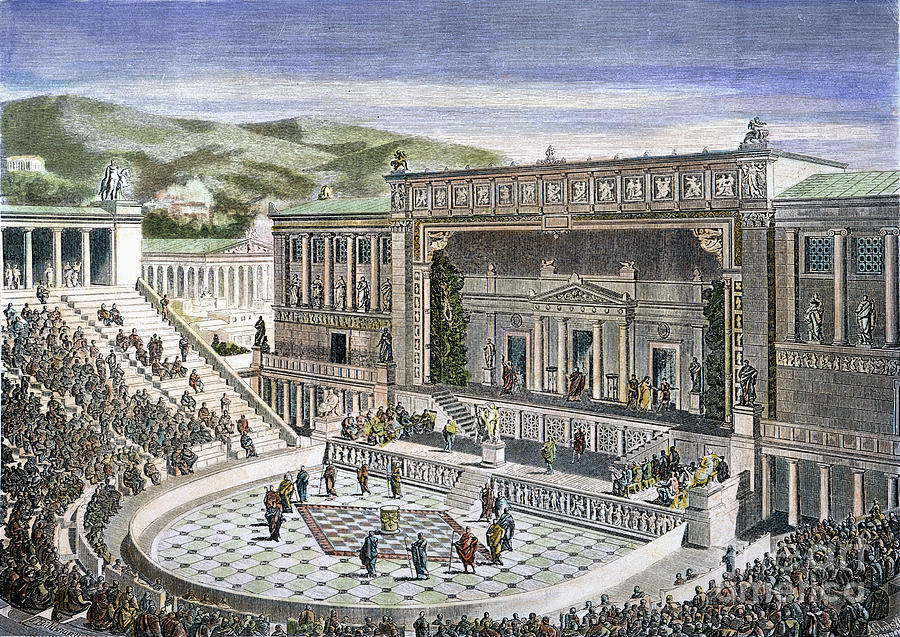
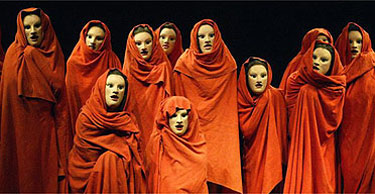
Greek Tragedy Theatre Mask ()


  • The image on the left is a representation of a theatre that the plays would be performed at. The circular stage at the bottom is called the Orchestra where the chorus sung and danced.
  • The central image is of a typical ancient Greek tragedy mask which is used to represent a character. Members of the chorus would where these masks.
  • The image on the right is of a typical Greek chorus which would have been made up from around 12-15 chorus members, of all whom would be male. They can be seen wearing the character masks and robes to represent the playwrights envision.
This research helped me understand the context of Greek tragedy which should mean I can start to imagine the devising, physical theatre and voice opportunities there are as a chorus for our script.