Saturday, 9 April 2016

Vocal Development Programme Updates

This is my monologue from 'The History Boys' and I am the character Irwin. He is a history teacher who pretends to be from Oxford university and has been employed to teach the boys how to get into Oxford. This monologue is near the end of the play where Irwin has recently been in a motorcycle accident and is now in a wheelchair and a presenter of a history TV programme. He is non sympathetic, very cynical, and has a very flippant and glib attitude to education.

Voice Monologue Week:

  • Target for this week: To improve on my articulation with the 'TH' sound so I can be fluent and understandable whilst performing my monologue.

Whilst studying this monologue I have found that I have trouble correctly articulating my 'TH' sounds. This line is an example;

'Not monks stumbling down the night stairs at three in the morning to sing the first office of the day'

I had trouble with this line due to the amount of 'TH' sounds in a sentence. It was like a tongue twister and I was muddling them up with my 'F' sounds.

This information lead me to choose an exercise called; The formation of the TH sound. This consists of me practicing the following;

  • OOTHOO
  • OHTHOH
  • AWTHAW
  • AHTHAH
  • AYTHAY
  • EETHEE
These exercises are too improve my unvoiced TH sounds and are getting my tongue used to the correct positioning and the amount of weight I press against the upper teeth. I am repeating these exercises 3 times a day, everyday this week which should help me achieve this weeks target.

To improve my voiced 'TH' sound I chose these words;

  • Thither
  • weather
  • mother
  • further
  • heather
  • therefore
I am saying each word one after the other so I can practice having more than one 'TH' sound in a line. This should improve my articulation and fluency whilst reading the line quoted above which contains many 'TH' sounds in a line, therefore, I see this exercise suitable to address the issues I have in this area of my voice.

Conclusion of Exercise

To conclude, I have been practicing forming my 'TH' sounds so that I can increase fluency when performing and so that I can be clear and well articulated all to ensure I perform my monologue with the correct flare, emotion and characterisation accurately without slurring some of the sounds that I would be unsure about without practicing these exercise above. I believe I have achieved this target above as being the end of the week, I have now been able to correctly form my 'TH' sounds and read some of the lines I was struggling on before clearly, therefore my articulation has improved and successfully carrying out my objective for this monologue.


The Wardrobe Week:

Target for this week: To increase the use of modulation, infliction and tone in a line to portray a change of emotional state.

During the Wardrobe I noticed that I had trouble portraying my changing emotional state due to lack of control when it came to inflection, modulation and tone. I have been working on this line in particular to try and control these factors to improve the way the my line is delivered to the audience.

'If any harm comes to Arthur I swear I will, I swear to God I will'

This line is said to Winifred right after she delivers the line'

'...Arthur's bones will twist and break against his father's stick'

Jaffrey is in dismay that Winifred has just brought up his secret 'lover' and is not only shocked to find out she knows and is willing to blackmail him, but the thought of anything happening to Arthur quickly changes the delivery of the line from the beginning where Jaffrey is angry, with 'rage and alarm' into more of an worried, panicking and frustrated Jaffrey who is quite scared of his friends well being.
In order to be able to achieve this fast change in emotion I practiced with these exercises below:

  • Stretch the tongue around the mouth to increase the range of movement and to give me more control over the power of my modulation and inflections I use.
  • A type of yog asana called 'Ujjhayani Pranayam' where  close my mouth and breathe through my nose and when I exhale, I hum and use vibrato to create a constant but ever changing, steady pitch to train my tonsils. This strengthens the tonsils which gives me more control over the vibrations used which in turn give me better control over the modulation, tone and inflection in my voice.
Conclusion of Exercise

To conclude, adding this exercise to my vocal development programme has helped me control the way I change my emotional state by strengthening my tonsils and allowing me to modulate and inflect different tones and pitches into a line to change the emotion and breeze a substantial new element to it to vitalise the audience with a fresh and powerful energy. I think further practicing this exercise will lead me to achieve my target and to improve further I could try and modulate with the tongue instead of the tonsils to build up the tongue muscle and strengthen that allowing for even more control and a much more efficient modulation of the voice.

Information from - http://www.voiceartistes.com/article4.html

The Cherry Orchard Week:

Target for this week: To increase my breath control to prevent the voice from being drawn back into the body.

During the Chery Orchard I had feedback from the our teacher that when delivering lines my voice can be drawn back into the throat which means that as I go to talk I have trouble forcing the breath up and out of my mouth giving me amplified, clear voice. Instead my breath can be directed down or die out before exiting the mouth meaning that the power and dynamics are lost and my voice can fall flat.

'Thank God, what time is it?'

This is the opening line to the play and it has to have energy and an instant impact to the audience to draw them into the play, the introduction to the story and so they don't give up on life before they have even seen the potential. To stop this from happening I would need to take a strong, deep breath, control the breath, projecting it out upwards but I believe that my breath was being drawn back into my throat preventing this projection and an exiting, impactful and energised entrance and intro.

To develop my breath control and projection I have chosen to carry out an exercise below:

  • Yawn to stretch the mouth and back of the throat allowing me to open my mouth further and giving me more control of breath
  • Breathe in through mouth and hold for as long as I can and then breathe out, repeat 5 times. This will increase the capacity of my lungs which will allow me to project more and strengthen the breath giving me more control to prevent it from going back into the throat
  • Deep breath in and hum up and outwards for as long as can, repeat 5 times This will allow me to get used to how much breath I will need to project this line out to the audience energetically.
Conclusion of Exercise

To conclude, adding these exercises to my vocal programme has helped me achieve my target of increasing breath control. I have seen an improvement in my breath capacity and have been getting used to the strength the breath needs to be and the direction it needs to flow out of the mouth in order to prevent it from being lost in the throat and instead be projected out to the audience in a successful way.

Greek Theatre Week:

Target for this week: To be able to carry out a strong and realistic accent of a young teenager in a creepy way with good projection and articulation.

In this Greek performance of the Orestia I found that my accent was off slightly and lacked emotion and enthusiasm and was a bit flat. The purpose of using the accent to say our lines in was to give our performance an eerie and creepy feel to it by using school children to portray the violent acts of which occur in the scene. An example of a line where I lost character slightly was:

'Harden yourself Orestes'

To correct my accent and to delve more into the school child persona while projecting out to the audience and keeping good articulation and character I will practice the following exercises:

  • The tip of the tongue, the teeth, the lips, the lips, the teeth, the tip of the tongue. This exercise educates many areas of my vocal inhibitors. It serves to control breathing so I can repeat the exercise for longer, strengthens the tongue and teaches me the control I need to form the words articulately and by doing this exercise in the school child accent and repeating it over and over again, gradually increasing exaggeration of the accent, articulation of punctuation and words and speed of the lines as well as projecting upwards and outwards all to help me improve my accent and characterise the persona we have chosen to perform as.
Conclusion of Exercise

To conclude, adding these exercises to my vocal development programme has helped me achieve my target of carrying out a strong characterised accent that portrays the emotions and persona that gives our performance a creepy perspective. I have been able to read my lines with the accent easier and at a more energised pace adding impact for the audience and overall believe that my accent for this performance has dramatically improved.

Finished Programme

I have now finished my vocal development programme and have improved on all aspects of performance styles from my very first plays like the Wardrobe, Greek theatre style, naturalism and my monologue. Finding these exercises and creating a plan and carrying this plan out for a period of time has got me into a cycle where I want to carry on improving my voice so I can go onto higher education with a well practiced, dynamic voice to use as a tool to have high standard future performances where I don't make the mistakes I have now corrected.

Wednesday, 23 March 2016

My Voice Portfolio

I am analysing the vocal characteristics of my voice using feedback I have gathered from friends and family and teacher who have been present during my performances, during class or have formulated a response about my general speaking voice outside of acting.

Some basic characteristics of my voice are from feedback from family members are:
  • Baritone
  • Clear
  • Modulates
  • Slightly breathy 
A positive of my voice during performance is that I have good inflection of the lines. Evidence of this is that during the Cherry Orchard and the line;

'you're brother Leonid here tells me I'm a bore and a 'salesmen''

I have good inflection in this line because; before the show, I straightened my posture, became aware or my tension and relaxed said tension. This made my diaphragm relaxed and more flexible, in turn allowing me to control my breathing and increase my breath capacity, therefore giving me greater control of the tone I chose to inflict upon at the end of the line and during the words, 'bore' and 'salesmen'. This allowed me to accurately portray the attitude Alexander was using to sarcastically talk about Leonid and therefore allows the audience to understand the intentions of the character, adding to the naturalism my voice had.

Another positive aspect of my voice is that I am clear, well articulated and have a quote; 'booming'  voice which I was told by my peers during feedback. Evidence of this is during the Cherry Orchard;

'the cherry orchard is mine'

where I had to portray an exited, overly happy and purposefully ignorant Alexander who was celebrating his purchase of the cherry orchard. In order to achieve this I made sure I maintained good posture, moved my breath into the lower area of my body and relaxed the muscles in my face by massaging the jaw and carrying out a small exercise  which I involved opening and closing the mouth. This warmed my body up and allowed my voice to be 'booming' but gave me the control I needed to keep clear articulation of the words and to also portray the emotion by inflicting different tones at the ends of lines. These combined allowed the audience to clearly hear my character and enabled the emotion to be heard through the words.

These two positives show how my voice is an effective tool for portraying the right emotions to the audience in a naturalistic play by being clear, well articulated and using intonations when necessary to enhance my performance.

A negative characteristic of my voice is that it can be very monotonous and deep when reading a line that I am un certain about such as this line in my monologue;

'the monistic life only comes alive when contemplating its toilet arrangements.'

This issue occurs when I do not understand the context or meaning or emotion I am meant to be portraying during the line and therefore this lack of understanding shows in my voice by monotone. I would describe it as being a similar situation to a learner driver driving slowly and carefully because they are unsure of the road and the vehicle. With my line, it is the same, I am unsure of the lines meaning and therefore take it slow and careful which involves ignoring the use of dynamics in my voice much like a first time driver has no dynamics during a gear change. This lack of dynamics leads to the line being boring and un interesting and all of the impact or naturalism or characterisation to be lost which could really show during a performance to the audience. In order to improve on this, when I read through the script, I mark all of the new thoughts and assign an emotion to them so when I come to a line I know exactly how to act it and exactly what tones and pitches I need to use. This works because my confidence increases and I become familiarised with the lines meaning and am able to portray it successfully.

'In the language of an actor, to know is synonymous with to feel'  -  Stanislavsky - I believe this quote represents my point above by me not knowing the line effected my voice. http://www.goodreads.com/author/quotes/54455.Konstantin_Stanislavski


Another negative characteristic of my voice is that I can become breathy which is caused by breath being pulled back into my throat instead of being used to strengthen my vocals. This can lead to lack of stage presence as although I have the power to project my voice out to the audience, at the ends of lines the breath can become weak and quite which stops me from having control over my projection and the dynamics. Evidence for this is from a line in my monologue from the 'History Boys';

'but what are these modern-day pilgrims gazing at but these same ancient rags, hallowed not by saintly usage, its true, but by time... and time alone?'

It is in long sentences like this one where I can become breathy. I believe to improve this I can carry out an exercise that increase my breath capacity such as taking a deep breath, holding it in for 10 seconds and releasing the breath whilst maintaining the equilibrium between the posture and relaxing the tension points and increasing the amount of seconds with each breath in.

Practitioners and Exercises


A suitable warm up exercise routine to improve my voice would be to; rotate the head in from side to side which stretches the neck muscles relieving tension and increasing motion, massaging the jaw and opening and closing it to expand the range of motion of the jaw to increase projection, moving down from the jaw to rotating the shoulders to increase motion and to relieve tension making my body more relaxed and bettering the posture making my breath more efficient, banging on the chest to massage the ribs and to open up the lungs which increases the airflow and therefore allows for more projection and dynamics such as intonation, inflection and modulation, then breathing into my abdomen and opening up my diaphragm to increase the airflow more giving me greater breath control and power in the voice which will allow me to control my articulation and, tone and pitch. Then stretching every muscle from the foot to the neck by tensing it and relaxing it which releases excess tension and makes the body more relaxed which in turn increases the efficiency of airflow and increases the dynamics of my voice. Then, moving onto some verbal exercises, take a deep breath in and pronounce some consistent sounds such as 'TH' 'F' 'M' and 'S' sounds. This will improve the articulation and get the lips warmed up increasing strength in the mouth and giving me more control over my pronunciation and execution of letters. Carrying out this exercise at home once a day and before a performance will allow me to perfect my characteristics and warm my voice up so I can perform; with high quality, naturalism, Greek theatre, Berkoff, Shakespeare and Brecht.


To Conclude

Overall, my vocal characteristics contain many aspects necessary for the many different performance types and is a very strong tool I have at my disposal as an actor but it has also highlighted to the areas of my voice I need to improve on so I can have a professionally developed voice during my performances and with my research, I now know the exercise and practice I must execute on a daily basis, to make these improvements come to life.


Sunday, 20 March 2016

The Oresteia - The Chorus Speaks; Blog

Blog Report

In week one we were given an insightful introduction to Greek tragedy of which was helped by my contextual research on the history of the ancient Greeks. We studied the use of voice in a chorus group and how there are many different ways to read the script in Greek theatre. One way to read the script was to have everyone read at the same time. The outcome of this was a very un organised clutter of mixed pitched voices which, in my opinion, gave me the impression that I was in a church and we were reading a prayer or we were part of a cult group who chant and repeat. This gave me the emotions of eeriness, evilness and creepiness but also sadness and loss and as thought the voices were trying to fill up a hollow whole of which life has escaped from. These stirrings that I felt from just this reading showed how effective the chorus can be even for one line. This; in turn, shows how the use of voice can create power and impact the audience. If I were to contemporaries this I may adapt the setting of a funeral where there has been a death and folk are mourning which would relate to the emotions it made me feel but maybe physicalize the dropping of the coffin into the ground by having one person as the coffin and the rest of the group being the rope lowering the coffin into the 'dirt'. This visual, initial response I had could use Frantic Assembly's lift which would also be a contemporary use of physicality in an otherwise ancient form of theatre,

Following on from the above, we were put into groups and given a scene where we had to use physicality and voice which we have previously been educated upon in order to contextually contemporaries the script of which we would be conjointly performing in nothing shorter than a weeks time.  We were given scene 1 which is about the voices or conscience inside Orestes  mind spearing him onto killing his mother due to her and her lover murdering Orestes father.

'Let all who have prayed for justice'

We read through the script and highlighted the key words we thought were most suited to being physicalized whilst representing what was happening in each line. For the first line in our script we chose the word 'prayed' because Orestes may have begged or prayed for justice to be carried out against his mother for what she did to his father. To show this we all walked around the room and became someone who was praying for something to happen, we collaborated together and crouched down while still praying. This gave a really clear representation of prayer but I decided, to make it more visually impacting, to stand up, spread my arms out. I actually visualised the Christ The Redeemer statue in Brazil. With this line physicalized, we needed to decide how we would speak. Ideas such as whisperings, prolonged usage of the 'ssss' sound and over exaggeration were a thought, but I believe Katrina or James came up with the idea of speaking like a 'common' school child using 'chavy' accents to read the line. We experimented and decided on the school kid accent and used it throughout the scene. In my opinion, I believe that sounding like school kids in a play which is about murder and death makes the experience for the audience very disturbing and creepy which would formulate an interesting reaction with the audience. This shows how we are contemporising the script for our modern day, teenage target audience.
Further contemporising our scene physicality and voice, we decided to not just sound like school children but to become school children throughout. We created an introduction to our scene which is set in a school playground. We experimented with what we could do in the space and how we could set the scene and we decided to have school bags, walk to the back of the stage and place our bags down. We played with slow motion when rising back up from the crouching position. I believe that this worked really well in showing the setting is in a modern day school playground which shows how we have further contemporised the text and the use of slow motion whilst standing up and then facing the audience should make a smooth transition into our spoken chorus work and be very creepy with should coincide with the school children theme and create a strong impact with the target audience and be very visually intriguing.

An idea I had during this line;

'That opens deadly flowers'

was for everyone to become the flower petals. I envisioned the cycle of a flower opening in spring and the movement of the petals in the wind. In order to achieve this we moved from our position at the end of the line;

'Cut through the tap rot of the vendetta'

which was James and I slicing our arm down the body of the girls. We speak the line and then turned our backs on eachother to create a circle of outwards facing 'petals'. We leaned over forwards and then majestically continued leaning forwards and backwards to physicalize the motion of opening of the flower. I think this section looks visually attractive and really physicalizes the key metaphor which should allow the audience to understand what the chorus is trying to portray clearer.


What We Modernised Through Physical Theatre

For the all boys scene we used Jacques Lecoq
technique where we choose an animal and physicalize it. Looking at the script, the theme of it is very dark and sinister and based around murder but the way it is written is as though the character; the chorus, is like an ant. A multitude of ants that are submissive and have leaders and who live in dirt but who work together to kill their prey using words to distract them until they 'surprise him'. With this, we decided that we should all physicalize insects. We did this by going from a zero emotion human state, walking around the room, and slowly becoming more and more insect like until we were at peak insect with our bodies hunched up and facial expressions really over emphasising a sort of hunger for the man were about to murder as it were. This shows how we have used a modern technique to contextualise our piece for contemporary use.

Link to information about Jacques Lecoq and his techniques - http://www.europamagna.org/pageshtml/Pgtheatre/SCOUT/StageIUFM/jlecoqeng.htm


What I Did Vocally In My Performance


For the opening scene, we all did a little exercise using the voice where we were tasked to carry out a series of characterisations such as;
  • Happy Plastic
  • Informative
  • Spider/Insect
Happy plastic is an over exaggerated but fake way of talking in a really happy way. I said the line;

'But our own grief makes it easy'

This line is not very happy at all, its theme is of sadness because they have grief and are suffering therefore plastic happy which is this fake happy adds a sort of sarcastic tone to the line making it relatable to our audience.

The informative voice was used at;

'We come at the command of Clytemnestra'

and is used because I believe it makes the line as though the chorus is convincing in a salesman way. The chorus are informing the character on stage about who they are and why they are here and are trying to sell themselves to the character so they are trusted like a salesman trying to become trustworthy so the consumer will buy their product. The thing that makes it sinister here is the 'product' the chorus are selling is themselves and its because they are in great grief and pain. I believe that this will shock the audience and make the scene even more darker and tragedy like.

The spider/insect like way of talking was inspired, once again by Jacque Lecoq's technique of becoming animal like, but this time I used the voice and slowly went from being human and neutral to creepy and elongating my words to sound what I believed was spiderlike. I used this for the line;

'the rips in our skin are fresh'

I envisioned spiders ripping through their prey so using the voice I can add to the physicality to make this line sound very nasty and 'creaturesque' which should in turn have a large positive impact on the audience and as a chorus sound powerful.

Overall, with the voice side of this project and every other factor I have recorded in this blog, I have been successful in achieving the criteria of creating a contextualised contemporary performance from an ancient Greek play, The Oresteia using physical theatre.


The Oresiteia - The Chorus Speaks; Blog

Historical Context and Research

Link to National Theatre website - http://www.nationaltheatre.org.uk/video/an-introduction-to-greek-tragedy


Ancient Greek theatre was most popular during the years 550BC and 220BC. Greek tragedy was one of the three dramatic genres, the others being comedy and satyr, which were performed as a festival to honour the god Dionysus in Athens.  Euripides was one of the most influential playwrights of the time whose work was still being developed and performed years after their initial first premier. Play wrights such  as Euripides created a foundation of which all contemporary theatre is based upon. These plays would have been  performed by an all male, amateur cast. Also, the playwrights would only use 3 actors on stage at a time.
Greek Tragedy Theatre Mask ()


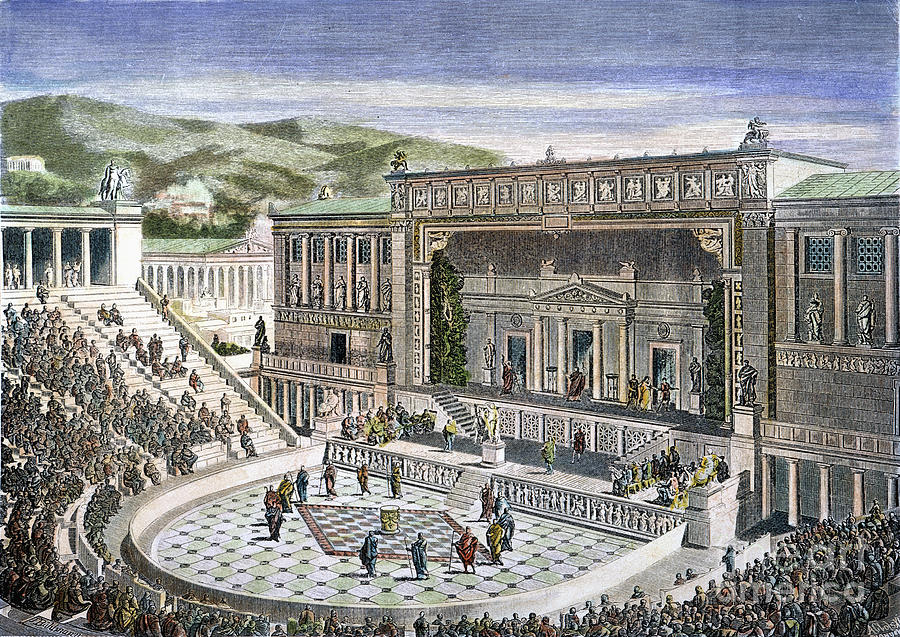
  • The image on the left is a representation of a theatre that the plays would be performed at. The circular stage at the bottom is called the Orchestra where the chorus sung and danced.
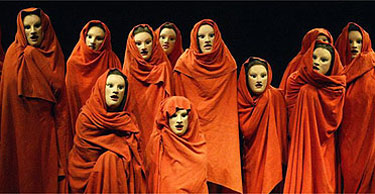
  • The central image is of a typical ancient Greek tragedy mask which is used to represent a character. Members of the chorus would where these masks.
  • The image on the right is of a typical Greek chorus which would have been made up from around 12-15 chorus members, of all whom would be male. They can be seen wearing the character masks and robes to represent the playwrights envision.
This research helped me understand the context of Greek tragedy which should mean I can start to imagine the devising, physical theatre and voice opportunities there are as a chorus for our script.


Tuesday, 16 February 2016

Uptown Blog Week Three

This week we devised a few scenes with members of the groups ideas from the stimulus, experimenting with different types of physical theatre we can use and with ways of improving the scene to impact the audience most effectively with the use of music as symbolism to increase the effectiveness of our performance.

Cathouse Scene

One of my initial responses was that the song was set in a 'cat house'. The term 'cathouse' is American slang for a brothel.

Information about a Brothel - http://www.merriam-webster.com/dictionary/brothel

A brothel is a prostitution business of which allows men to walk into their building and engage in sexual activities in exchange for money. Brothels specific to the 1940's may have been owned or run by gangs or the mafia and was often a place of drug dealing.


Images from - https://en.wikipedia.org/wiki/Brothel 

This information gave us an idea for setting up 5 chairs onstage and having the males sit down whilst the females performed a type of hymns hand, chair duet with some relevant 'lustful' jazz music and dark lighting. In my opinion, without this information we would not have known our target of lust and passion for sexual activity and therefore our scene would lack era correctness and would have been pointless to the audience.

With this research, we firstly decided to set the chairs into a five dice shape (on the right). We experimented with how we would move the chairs on stage. First we dragged them on but it looked messy and was loud. We then lifted them up and placed them down gently to symbolise the meaning of gentle lust and smoothness of the scenes motive. I believe this small improvement has added the smallest amount of impact but will serve to smoothen this scene off and give it more performance potential.
The females of the group had to then choreograph the physical theatre. Yasmin seemed to take directional control this time and invented some of the interactions with the motive of lust and sexiness in mind. Their was one girl interacting with one boy and they went around, one by one to create their own set of movements which the rest of the girls had to copy. We then ran through and practised this and it was achieving the motive for the scene and therefore we were all happy. By doing this, we have given the scene performance potential and dramatic potential and have thought about staging and theatrical devises through experimentation and improvisation, team work and positivity. Image from - http://images.dpchallenge.com/images_challenge/0-999/339/800/Copyrighted_Image_Reuse_Prohibited_174319.jpg

To further develop this scene, we added some music. To find music suitable, I envisioned jazz because of the era of the 1940's and how it linked in with the stimulus. I found an album of 'sexy' jazz music, https://www.youtube.com/watch?v=k3_tw44QsZQ, from this link. I think this music will make the audience feel like they have just entered a cat house and that the physical theatre will only be enhanced by it.

We decided to experiment with the use of character masks for this scene. Rhys, Logan, Mike and I all chose a tresle' mask each that symbolised a suitable characteristic of someone who is in a cat house. We ran through the scene with the masks on and found that it solved a problem that we had where the boys were not making facial expressions or acting towards the girls movements. The use of masks means that we had a set facial expression which would show a set characterisation to the audience which should allow the audience to understand the motive of lustful love in the scene.

We then experimented with getting the chairs off. Logan decided to cartwheel over the chair for some reason. This random demonstration kind of caught on and then, after much practice, we managed to cartwheel over the chair and then walk off. I think that this will add to the scenes performance potential and dramatic potential as it is visually aesthetic and could represent the happy end of sexual activities that the men would have taken part in inside a brothel. This shows how we have used physical theatre to enhance even the slightest of movement in our scene and how the potential for the scene is increasing and how improvements are being made constantly to better the quality and impact the audience will have when watching.

With this scene, we found that we could develop a story. I came up with the idea of a story where we follow a mafia gang through childhood, to adulthood and the different types of love they would face. The audience would see the different types of love that are in existence through the individual scenes that represent a different variation of the emotion. With this Cathouse scene, as a group, we found that James, wo was in the middle chair, could actually represent a man who has a girlfriend who is in love with him, but she finds him in a brothel and through physical theatre, show her emotions when she finds out where he has been.
In order for the audience to see this motive, Yasmin and James had to choreograph a piece of physical theatre. They devised a piece where at the end of the brothel scene, the prostitutes and gang members would all walk off apart from James. Yasmin finds him there and pushes him away and forces him onto the chair. This physical theatre will hopefully show how Yasmin's character is upset with James' character and how this type of  love exists in the world which in turn, should impact the audience and allow them to be educated on the subject of love itself.
With this in place, someone came up with the idea of Logan and James being in a homosexual relationship behind Yasmin's back. This lead to the idea of everyone being paired into boy and girl partners. The partners were;

  • Rhys and Beckie
  • Pau and Chloe S
  • Chloe H and Logan
  • Yasmin and James
  • Mike and Becca
With these partners in place, we left the idea until we finished James, Logan and Yas' scene. With Logan being in a relationship with James. We were able to create a beginning to this cat house scene which would aim to show the audience how in the 1940's, homosexuality was still not widely exepted and therefore relationships were secretive.

Homosexuality in the 1940's America


Sodomy Laws in 1940s America ('48 Magazine)
This information gives evidence to the laws and punishments against certain sex crimes in the 1940's and also information about the rights homosexual people had.

With this research we James, Logan and Yas could develop their small scene at the beginning of the cat house scene. They experimented with Yas and James dancing at first and then finding a way for Logan to interact. This research allowed James and Logan to have the motive of being secretive and careful and cautious and so they decided to use gentle movements, subtle and meaningful hymns hands with Logan pulling James away from Yasmin and Yasmin believing James and herself are in love even though it is Logan and James who are in love. The staging is that they stand in the middle/front of the stage and the audience have a side view of the physical theatre which will show the audience all three of the different interactions and allow the audience to be influenced by the homosexuality law of the era and the different way love has affect which is the motive for the scene.

Overall, with everything in place for this cathouse scene and with the added extra of James, Yas and Logan's scene, what we have all achieved this week is a piece of devising work that, from the stimulus and research, and using physical theatre, finding motives of what we want the audience to understand and creating a story to experiment with, we have all worked as a team, with positivity, to create something which has performance potential, dramatic potential, whilst looking at staging, characterisation and the era of which it is set in.


Saturday, 6 February 2016

'Uptown' Blog Week Two

Research of Historic Events

Week two we came back and researched our ideas and found out the historical context and other facts that may help us develop a more realistic and informative piece of theatre to our audience. In turn, giving our performance more of an impact and also educating them about the events of the past and finding out and showing how these ideas relate to the stimulus, 'Let me off uptown'.


The Great Depression Quick Fire Facts
  • From 1929 - 1939
  • The largest economic downturn in the history of the United States of America
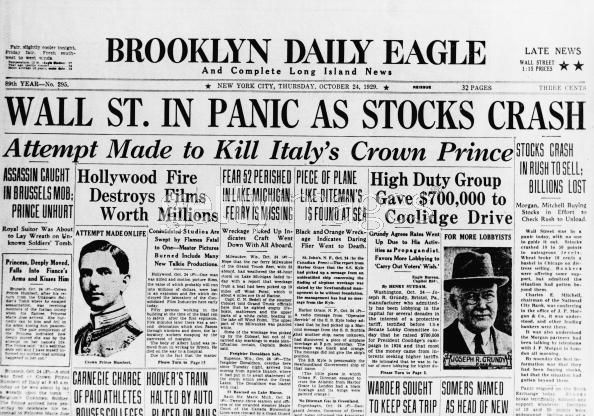
  • Caused by the Wall Street stock market crash in 1929
  • This meant that consumer spending and investment dropped
  • Industrial output then steeply declined
  • Failing companies then laid off their workers
  • This lead to mass unemployment
  • In 1933, 13-15 million Americans were unemployed
  • Nearly half the countries banks had failed and run bankrupt
  • The un employed turned to the 'American Dream'
  • This being the dream of earning enough money so they could afford to live of their own land
  • These workers found employment in farms in the country

history.com/topics/great-depression - the link to where this information is from
http://www.history.com/topics/great-depression/speeches - this is President Franklin D. Roosevelt's radio broadcast where he praises a newly adopted works relief program which would introduce retirement and pensions to the elderly therefore bringing more jobs to the youth.

This research about the great depression allowed us to start developing a scene based on the workers on a farm which was developed by Rhys and I. As a group we chose frantic assembly's Four corners as the physical theatre for this piece.


"The vibrant and visceral Frantic Assembly" THE INDEPENDENT

Frantic Assembly is a physical theatre company founded by Artistic Director Scott Graham, Steven Hoggett and Vicki Middleton in 1994. They create 'thrilling, energetic and unforgettable' theatre using their own techniques such as; chair duets, four corners, jet pack lift, wall running and hymns hands.

Four Corners and the Great Depression Scene

The technique we tested for this great depression scene was four corners. Four corners involved me choosing four points in the room and then travelling to these points, and only these points. To use this to create a scene, me and Rhys split the group into four and placed each group into the corners. Then these groups chose their four corners. Firstly we all set off at the same time and just walked to our four corners and then back to the position without any physicality or characterisation or interaction. This was very bland and had no dramatic potential so the group decided to set off in cannon. After setting off we found this added more technicality to this scene but was still lacking in dramatic interest. So, I came up with the idea using the research Rhys had completed about the Great Depression, which shows the social classes that existed around the working farms of 1929-39.

Social Classes on working farms during the Great Depression era


  • There were the land owners who had the money and were in charge of all of the workers on their land. They have the highest social class as they have both money and power.
    Under these are the landowners children. Especially the male child due to sexism of the time; (information on sexism during the Great Depression can be found here)-https://prezi.com/hunydkrsud9d/sexism-in-the-1930s/
  • ...the male child would have the same authority over the workers as the landowner but has not inherited the money.
  • Then the wives of the landowners or their sons. These would be dressed and treated as lady's and have authority over the workers but may be treated unfairly and be powerless to the landowner or their child due to being a woman.
  • Then the white workers, these are the 'non black' workers that live on the farm to earn a small living. These men have no power or authority and very little money. They are lower class people and would often be left for dead once sacked of old age.
  • Then the black African American workers. These men have no power or authority over anything and were treated awfully due to the racism of the time. They were often kept as slaves on cotton fields. During this period, they still had barely any rights and were often lynched or hung by large mobs of white men due to the completion for work. (Information on racism during the Great Depression can be found here)- http://www.bbc.co.uk/schools/gcsebitesize/english_literature/prosemockingbird/0prose_mockingbird_contrev2.shtml


Back to the Four Corners idea...

So with this information, we assigned Rhys and I the social status of the landowner and his son, Beckie and Becca the social status of the Lady/ wives of the landowner and his son, Chloe Hearn, Chloe Smith and Mike the social statuses of the white workers and Logan and James the social class of Black workers/ slaves. We experimented with the way we interacted with each-other until it told a story and made sure our movements were very physicalized. This meant we had created a short scene with performance potential and dramatic potential whilst thinking about the place, time and events and staging.
To further develop this scene, at the end of a cycle of four corners, we all collaborated into the middle facing the audience, and formed a freeze frame where one by one, a person has to carry out a frozen action whilst making contact with at least one other character on stage in order to show to tell a story or meaning to the audience. I think this really worked because it is a use of physical theatre that is very dramatic and unique. I do believe that this whole idea we created today has performance potential and shows how as a group we have created a suitable scene for our devised work.

This idea links to the stimulus because 'let me off uptown' is a jazz song and the genre of jazz was founded during the Great Depression and influenced by the large black culture in America.


Mental Asylum Idea

This idea was formulated by Sir James Welland. He told the group that 'Let me off uptown' made him picture a mental asylum where the stimulus was playing from a radio with static and mental patients laying on ill stated beds or the floor. So with this in mind, some research was done on what a mental asylum looked like in the 1940's:

Here is a working mental hospital from the 1940's with nurses and patients. It looks very over crowded but clean and medical. For James' idea, we needed something more sinister and dark as we felt we wanted to show the audience the dark reality of the mental issues that some of the patients would be suffering from and by creating a setting that physically objectifies these illnesses would make the scene visually educational and impactful. 
https://blogger.googleusercontent.com/img/b/R29vZ2xl/AVvXsEj6hR2l7CH5Iv-d2HaWR0ivvmw9UTKk8RIIsJ-bJV6hg0Lm4oRRFIXlgrlcnOvV9rs5QbPUMBzKujk32639Oi_yk9Vq66JgNtFcznqLxDQXWrHx_-mh5LFBlvdjzPBV3Tfs9n760Rdipvk/s1600/ww2hospital_c1940.jpg
-(link to image)


Here is an abandoned mental asylum. This gave us more inspiration on what our set could look like and fits in with the darker tone we were thinking of.


To make our set look similar to this picture above, we messily arranged blocks on stage. We then researched some mental illnesses:
  • Clinical depression - a low state of being to the point of ending your own life, causes such as low self esteem and loss of interest in activities or pleasure.
  • Schizophrenia - the failure to recognise what is real, hearing voices, fast beliefs or confused thinking.
  • Bipolar Disorder - periods of happiness quickly into sadness or anger or depression.
 
 Links to images above:

Physicalization of this scene

As a group we decided we should take a Forced Entertainment approach, using repetition and physicality and over expression to create a tense atmosphere and to make the audience feel they were actually in a mental hospital. We did this by finding a position on one of the blocks or on the floor and laying down. We used energy states to experiment with a feeling of waking up and slowly increasing the amount of energy until it got really loud and the tension could be created.
once at the optimum energy to be sat up and moving, we found three movements that, for me, were based on the bipolarism disorder. I had a coin that I was flicking and I was smiling and then frowning to really physicalize my character.
Our feed back from this scene was that the energy needed too increase a lot more, and that we should experiment with sound effects and larger movements and make it really over dramatic so that it could be really powerful and impactful to the audience. After this feedback, we tried some of Karen's ideas but it didn't really seem to work as I don't think certain individuals were convinced about this idea which lead to the energy lacking and therefore a lack of improvement of the development with the scene. We added the stimulus and used static to add to the scenes potential but as a group I feel we decided that it was too long and lacked the dramatic potential we had hoped. Also, this idea was called a 'cliché' idea and we decided we waned to steer clear from clichés and be more original and inventive.

Forced Entertainment - http://www.forcedentertainment.com/

Forced Entertainment are a group of 6 people that are based in Sheffield and make physical theatre performances. They explore and question aspects of life and art and improvise scenes by throwing ideas out between each other and devise 'until something starts to kick'. They use nudity, masks, costumes, create a mess on stage and use repetition, interact with the audience, break character and improvise whilst on stage.
This company is a great inspiration and educational gift for our group because as a devising company themselves, their techniques can be used to improvise scenes with performance and dramatic potential and that is the aim for our group. By researching this company we have used some of their techniques to create a purpose for our scene, and for our idea to have performance and dramatic potential.
 

Conclusion

Overall, this week has been a very productive week in terms of ideas being invented and brought to life with the use of physical theatre, acting and music which has shown our imaginativeness, insightfulness and teamwork and positivity even when an idea may not have worked for us.


Friday, 5 February 2016

Uptown Blog: Week One

Without Knowledge of the Stimulus

After listening to 'Let me off uptown' and writing down my initial responses, the groups were decided. In our groups we went round and shared our ideas and created a spider diagram.


This is the sheet where, as a group, our initial ideas were recorded. These are the first thoughts from every member of the group.

My responses that I shared to the group were:
. Mafia
. Jazzy/Bluesy
. 1940's America
. Boston or New York
. Cat House/ strip joint
. Black man
. White Woman
. Happy

James said he could imagine being in a mental asylum with the stimulus mixed with the sound of static. Chloe Smith felt like she was in a murder mystery case in 1940's England. Mike imagined himself in the West End show West Side Story, Yasmin pictured a cigarette smoke filled bar with slooty women and a very sexy atmosphere. Other imagined ideas were thrown up like a swing band and gangsters.
All of these initial ideas have been imagined without even knowing the stimulus and already show how; as a group, we have been used productive thinking and teamwork to share ideas which may be used later on down the line.

After Knowledge of the Stimulus

When we were given the knowledge of the stimulus we were able to compare the ideas and initial responses we had. With this, we were able to come up with themes that relate to the 1940's. We came up with themes such as War (ww2), The Great Depression, the Jazz era, Slavery and black rights, feminism and female rights, Mafia and gang violence, British murder mystery and prison/ mental asylum.

British Murder Mystery

Chloe Smith thought of an idea based around the game 'Cluedo'. Cluedo is a murder mysteries board game for three- six players invented by Anthony E. Pratt in Birmingham, UK. The overall objective of Cluedo is to find out who murdered the victim, where the crime occurred and the murder weapon.

https://en.wikipedia.org/wiki/Cluedo - link to the research about Cluedo

With this in mind, we went forth and explored this idea. We decided to assign ourselves a character from the game Cluedo and related them to Commedia Del Arte Characters:

Characters from Cluedo;
  • Miss Scarlett
  • Professor Plum
  • Mrs. Peacock
  • Reverend Green
  • Colonel Mustard
  • Mrs. White
Characters from Commedia Del Arte:

Commedia Del Arte Research

Commedia Del Arte was founded in the 1600's in Venice, Italy. It was a form of improvised street theatre where scenarios were created where stock characters that are based on masters, lovers and servants perform and interact with each other.
It is a very physicalized form of theatre where each character has
their own movements, way of speech and  identity and their own
mask.
This image shows actors performing as some of the characters in Commedia with the masks and costumes that represent their individual habits and traits.

I chose to be Dottore, and professor Plum because they represent a high social class and I felt they shared the most similarities. With everyone having an identity, we walked around the room in character and interacted with each other to experiment with actions, voices and physicality. With this, James sat out and watched.
We found that the characterisation and interaction started to tell a story of 'who was the murder'. By including the use of physical theatre, It gave this idea, performance potential, and could be developed further into a full scene.

Overall, in week one we have collected everyone's individual responses, chosen a few of them to work on and have started to develop them into scenes with performance potential, dramatic potential and physical theatre whilst evolving new ideas.